


1 fruit, 1000+ varieties: everything you didn't know about mango
Have you ever eaten a mango? Probably yes. It was most likely the Tommy Atkins or Kent variety: the same hard green-red fruits from the supermarket that arrive by sea. And you've almost certainly never tasted 999 of the other varieties of the same fruit — not even in the form of dried slices.
Mango isn't just an exotic fruit on a shop shelf. It's a huge family with 4000 years of history, 1500 names, and the only official title in the fruit world: “king.” This article is a short tour through that kingdom.

The official name of mango is Mangifera indica — literally “Indian mango-bearer.” In India people eat it the way we eat apples: by the handful, on the go, 10 pieces per season.
A fruit older than it seems
Archaeological traces of mango on the Indian subcontinent go back at least 4000 years. Petrified remains in the Ganges valley, mentions in the Vedas under the name amra, images in Buddhist parables — all of this is much older than tea culture in China or grape culture in Europe.
But if you dig deeper into botany, it turns out that mango has been on the planet for around 25 million years. Wild ancestors grew in what is now northeast India, Myanmar and Bangladesh. From there the fruit first spread across Southeast Asia, and then (with Portuguese traders in the 16th century) across Africa and the Americas.
The “Alphonso” variety, today considered the king of Indian mangoes, is named after the Portuguese governor Afonso de Albuquerque. The Portuguese began grafting mango in Goa in the 16th century and along the way gifted the world a technique that later spread across the tropics.
Botanically, mango is a close relative of the cashew and the pistachio. All 3 belong to the family Anacardiaceae. If you have an allergy to cashews or pistachios, it's worth being careful with mango: sometimes the reaction is cross-reactive.
Anacardiaceae: a family with roughly 860 species. The most famous edible ones: mango, cashew, pistachio, pink pepper. The most famous inedible ones: sumac and poison ivy.
Why there are so many varieties
India officially catalogs around 1500 mango varieties, of which about 1000 are in commercial circulation. Worldwide the figure is even higher: each producing country adds its own local names and hybrids.
Varieties differ across 5 parameters: size (from small “chicken egg” fruits to 800-gram giants), skin color (green, yellow, red, pink, mottled), flesh color (from pale cream to deep orange), texture (fibrous or oily-smooth), and flavor (from honeyed to spicy-resinous).
If a mango on the shelf has no fragrance, it isn't ripe yet. Let the fruit sit for 2–3 days at room temperature and the aroma will appear. After that, put it in the fridge — no longer than 5 days.
Star varieties: 6 names worth remembering
- Alphonso, IndiaSmall, golden-yellow, fiber-free. In India it's called the “king of mangoes.” The season is short: April, May, June. The go-to mango for gifts and desserts.
- Carabao, PhilippinesIn 1995 it was entered into the Guinness Book of Records as the sweetest variety in the world. Thin yellow skin, honeyed flesh.
- Nam Dok Mai, ThailandThe very same variety served with sticky rice and coconut milk. Elongated, amber-yellow, very sweet, almost fiber-free.
- Tommy Atkins and Kent: Mexico, Brazil, PeruThe most frequent guests in European supermarkets. Not the most fragrant, but sturdy: they handle transport and keep for a long time. Kent is juicier and sweeter than Tommy Atkins.
- Chaunsa, PakistanYellow-orange flesh, honeyed flavor with a hint of tartness. Grown in Multan. The favorite variety of the Pakistani diaspora around the world.
- Kesar, Gujarat, IndiaNamed for its saffron-like aroma. Oval, medium-sized, with a beautifully balanced sweet-tart flavor. The champion of internal-export volume in India.
Altogether, these are 6 varieties out of 1000+. The chances you've tasted at least 3 from this list in everyday life are pretty slim.
Who feeds the world with mango
The global mango harvest in 2023: around 61 million tonnes. And nearly half of that comes from a single country.
India grows around 26 million tonnes a year: about 43% of the world's mangoes. Yet less than 1% of India's harvest goes to export — the country eats almost all of it itself.
Vietnam doesn't appear in this top 7, but it's a notable mango producer in Southeast Asia: a long warm season and a well-developed drying industry. That's where our sugar-free dried mango comes from: one ingredient on the label, “mango,” with no sweeteners.
That's why the mango you usually see on European shelves is more likely to be Tommy Atkins from Mexico, Brazil, Peru or Ecuador. Alphonso or Carabao rarely make it here — and when they do, they cost as much as a small celebration.
What's inside: vitamins and benefits
100 grams of fresh mango flesh contains about 36 mg of vitamin C (roughly 40% of an adult's daily norm) and a notable dose of vitamin A precursor in the form of beta-carotene (about 25% of the daily norm). Plus gentle fiber, potassium and magnesium.
The orange color of mango flesh is beta-carotene — the same pigment found in carrots and pumpkins. In the body it's converted into vitamin A: important for vision, skin and immunity.
In dried mango vitamin C partly breaks down (light, heat, time), but beta-carotene and fiber handle drying beautifully — they are heat-resistant. Sugar and calories become concentrated: 100 grams of dried gives around 340 kcal versus 60 kcal in the fresh version. That isn't “bad” — it's just a different format: a small handful = a real, filling bite.
Why you'll never taste most varieties fresh
Here it comes down to physics and logistics. Most of the best varieties (Alphonso, Carabao, Nam Dok Mai, Kesar) have very delicate flesh and a short season. Transporting them fresh halfway around the planet is almost impossible: they either arrive green and never ripen, or arrive overripe and leaking.
What follows is a slightly frustrating paradox: a fruit with 1000+ varieties is represented on supermarket shelves by 2–3 versions. All the others live only where they grow.
The solution people came up with 1000 years ago: drying. Ripe mangoes are cut into thin slices and dried with warm airflow. The water leaves, the aroma and amber color stay. Sugar-free dried mango isn't tied to the season: you can eat it in December in Riga just as you would in June in Mumbai.
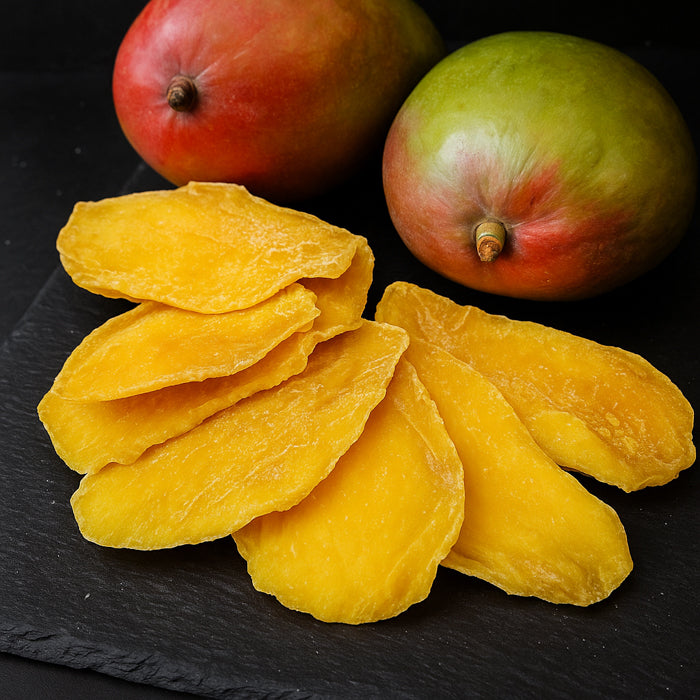
The flavor of this mango is dense as honey: 1 slice replaces half a fresh fruit. And it's finally in no rush.
Have you tried Indian Alphonso or Filipino Carabao fresh? If not, dried mango carries over the same honeyed, concentrated sweet note that these varieties are loved for at home.
Frequently asked questions about mango
Mango isn't 1 fruit — it's 1000+ varieties with 4000 years of history. In Europe we see 2–3 “logistical” versions, like Tommy Atkins. To taste the same honeyed, concentrated sweetness of Alphonso or Carabao, you don't have to fly to India or the Philippines: dried slices carry it across the year.